Spain has had some good media reports recently – if only from abroad. It started in December with Italy’s L’Espresso naming Sánchez the person of the year. The New Statesman followed with an enthusiastic write-up, and an article late last month at the FT said that ‘Spain leads the formerly weak southern EU economies that are now outpacing France and Germany’. The Spanish economy is doing well, there are plenty of tourists and the appreciation of Spain’s culture domestically, says the Government, is on the increase.
But let’s jump to where Spain’s brand of socialism is taking the country today.
The New York Times just last week ran an article written by Sánchez himself: ‘I’m the Prime Minister of Spain. This is why the West needs migrants.’ Yes, one-sided you might say, after all, he wrote it to justify his policies; but look where it shows up!
His ‘guest essay’ appeared to diss President Trump: ‘…What should we do with these people? Some leaders have chosen to hunt them down and deport them through operations that are both unlawful and cruel. My government has chosen a different way: a fast and simple path to regularize their immigration status…’. Furthermore, he writes, the plan ‘…is endorsed by more than 900 nongovernmental organizations, including the Catholic Church, and it has the support of business associations and trade unions alike. More important, it is backed by the people’. The Guardian picks up on this with: ‘Yes, migrants are key to Spain’s economic boom. But Pedro Sánchez’s decision to regularise 500,000 people should rather be applauded for its humanity’.
Spain is getting used to bucking Western political trends. ‘Last year they recognized Palestine as a state, resisted President Trump’s demand that NATO members increase their defence spending to 5% of GDP and doubled down on diversity, equity, and inclusion programs. But there can be no better example of Spain going its own way than with immigration’.
Or perhaps we could argue the merits of the new proposal to ban the use of social media for the under-sixteens. ‘First’, said Sánchez at the World Governments Summit in Dubai last week, ‘We will change the law in Spain to hold platform executives legally accountable for the many infringements taking place on their sites’.
Do Spaniards support restricting social media for children? 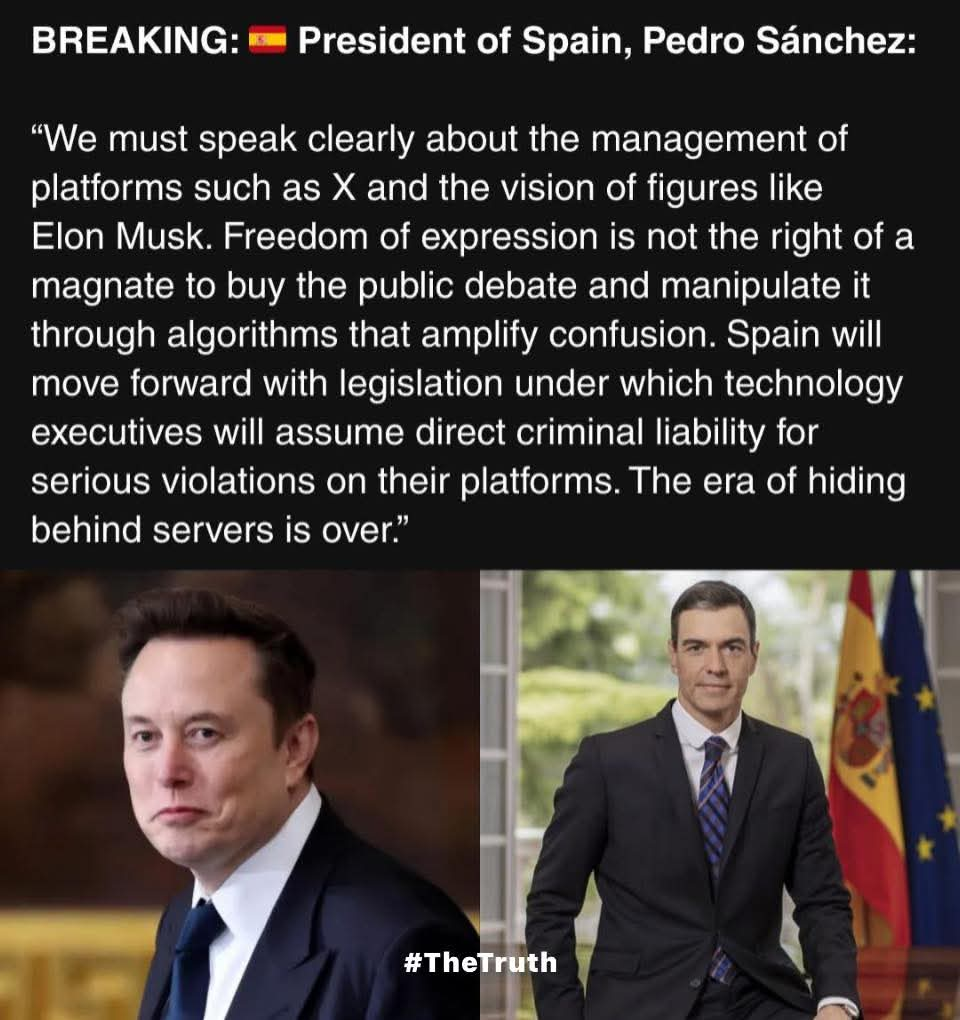
A Spanish poll a year ago asked whether children under 14 should be banned from using social media: 82% agreed. The current plan of course is for the under-16s.
The Spectator (that bastion of British Conservative thought) says ‘Spain’s PM is on the right side of this battle’.
The X and Telegram owners don’t like the idea – with Elon Musk calling Sánchez ‘a dirty tyrant and traitor to the people of Spain’ and Pavel Durov writing in a long screed on Telegram directly to his Spanish subscribers (including the under-sixteens), that ‘the measures announced by Sánchez are not safeguards, but rather steps toward total control to censor his critics, and that they must fight for their rights’.
On the strength of this, could other apps – maybe purely commercial ones – feel encouraged to send out to subscribers their political opinions?
Sánchez answered this on X with an apparent allusion to Don Quixote: "Let the techno-oligarchs bark, Sancho, it's a sign that we're riding forwards."
It’s certainly a special moment: where a foreign businessman can circumnavigate The State and appeal with propaganda aimed directly at his Spanish followers.
Internet access is starting at increasingly younger ages, and it's not just teenagers who are hyperconnected. 42% of children admit to having browsed the internet before the age of eight, and half of 15-year-olds spend at least thirty hours a week in front of a screen, according to an OECD report.
There will be problems: What age verification systems will be used? How will concerns about the privacy risks of providing proof of age be addressed? To what extent will adult access to social media be restricted to protect minors?
Beyond showing fluffy kittens and creating social bonding, we read that the threats from social media are many, and over half of all teens have experienced some form of cyberbullying, damage in self-esteem, sexual threats, misleading content, scams, risk-taking, challenges, hate-speech and dodgy advertising and claims.
And, for that matter, with less sleep and time left for other activities.
In all, Pedro Sánchez demonstrates that the obligation of a good government is to look out for and protect its people, not someone else’s billionaires.