I’m back from a fortnight’s holiday – to a village in the sun-lit green fields of southern Germany. Beautiful walks (they have walking- and cycling-paths that go through the fields and forests rather than as here: a painted-red strip alongside the roads), there’s a local children’s zoo with ducks and lambs and budgerigars, and lots of storks nesting high above the chiringuito where the adults stay for lunch and a drink; and there’s a local glider club with a whisper of sound as the aircraft land on the meadow after a few turns in the sky above.
All very nice. We stayed in mostly and watched television.
Now returned on Election Day to my village on the Almería coast, my children wanted to ‘take me out for a tapa’. This means, translated into English, to go and have a drink or two.
So we did, and duly refreshed, I thought I’d write about Mojácar’s bars, which come, as only fair, in many different shapes and sizes.
I remember the first time I got drunk. I was fifteen and had gone with my parents to some party in the village given by an odd Spanish-American couple who were, I have to say, a little creepy. They served champán (as it was called in those days). I was given a glass of this sickly stuff as my dad explored the house looking for something better to drink. He soon struck gold when he found a bottle of Johnny Walker stashed in the washing machine.
I thought it tasted even worse than the bubbly.
Later on, I was sick down my father’s shirt and we all went home. 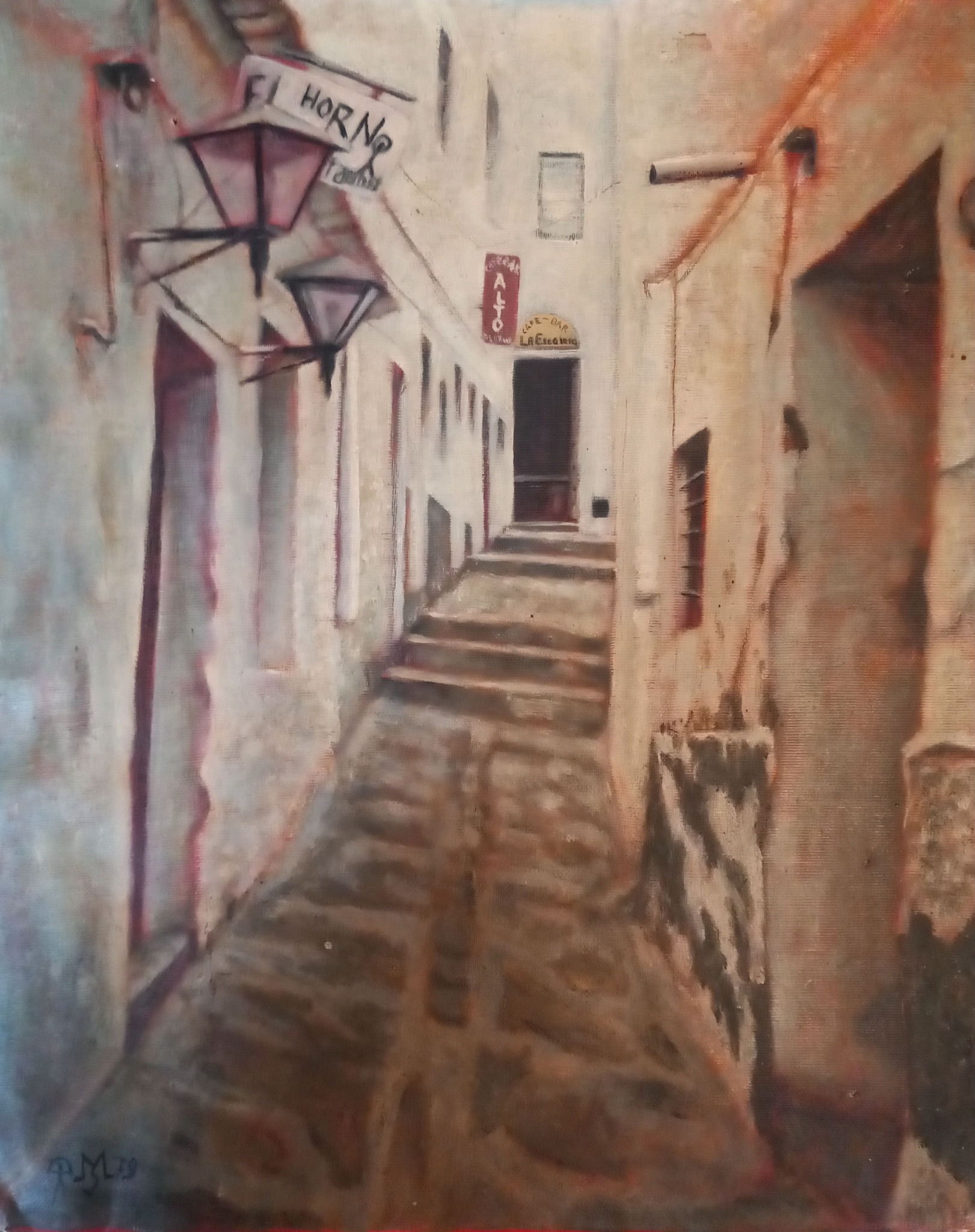
Mojácar back in the early days (in my case, the late sixties) only had a couple of local bars in the village, plus a tiny night-club in the arch run by madrileños and a discothèque owned by Philippe, a Frenchman from Casablanca (25 pesetas a gin and tonic). There were also a small number of bar/restaurants on the beach – plus a Government-owned Parador Hotel and towards the fishing village next door, a French-Algerian run restaurant with a cook from Maxim’s in Paris. If you made it as far as Garrucha, a fisherman’s bar opened at one in the morning – idea for that final carajillo.
The French place, El Rancho del Mar, had excellent food and a roof terrace one could sit on. My dad fell off it once and, as he picked bits of cactus spines out of his back, falsely accused the owner of pushing him.
We lived in the village in the upper of two apartments, bought (according to the escritura I still have) for 90,000 pesetas, which is 540 euros. Now, I agree that people used to pay partly in ‘black’ with the bank-manager seated in the corner at the notary and holding a suspicious-looking package, but Mojácar was in those days quite ridiculously cheap.
Probably a point of contention these days: ‘My dad sold your dad a plot of land for pocket change…’. Well amigo, that’s for sure.
We rented the downstairs to the son of the Rancho for 1,000 pesetas and just across the way, my dad bought an old house, fixed it up with a plank of wood and a fridge, and opened his own bar. This was called La Sartén and served the community for the next half century (under various hands – my dad was strictly ‘customer class’). Sad to say, it’s now gone.
There were a number of foreign bars in the village in those times when few people lived on the playa, a couple of kilometres below. Americans Arthur and Geri had The Saloon (my dad – again – once kicked Dennis Hopper up the backside there). Sammy and Charlie Braun ran the Zorbas – both of them out to seduce tourists, according to their gender. Bob from London had La Escalera, where one could sit outside on the public stairwell and be noisy.
There was a Dutch bar, An Anglo-French eatery, an Indonesian restaurant, Mamabel’s Spanish restaurant, and an English breakfast place run by a retired nurse who would give you your injection in the lavatory… all gone now.
Now it’s rather a village of souvenirs, guided tours and improbable fictions.
Spain has a lot of bars. The Spanish don’t tend to visit them with the intention of getting drunk (Well Done, those tapas!) but to socialise and even arrange business deals over a cold caña. In Almería, there’s a bar for every 126 inhabitants. The winner though, is León with an incredible 79 neighbours for each and every caff and Granada coming next with 87.
There is, after all, nothing much on the television.
Our strip of coast has grown with over twenty beach-bars, several hotels, many restaurants and so on (Google says there are 150 establishments now, making Mojácar, visitors aside, about one drinking place for every forty residents. If you had stayed home to watch Eurovision the other night, the town would have gone bust!).
We are lost for choice – although most of us have a very small number of preferred venues.
My dad and all his friends drank too much, too fast and too well and they are all in the cemetery now. Indeed, if you visit late at night, you might be able to hear the furtive sound of a champagne bottle being opened and the bubble of muted laughter.
Me, I stick to beer.
...
Painting from Michael Sucker. Mojácar Calle del Horno 1979.