 Time was, when I was younger, Spanish wines had a bad reputation. In the UK, the Netherlands and Germany they were the cheapest on the market and in France - well, they had their own fine Bordeaux and Burgundy wines, as well as excellent vins de pays.
[FontSpace]
Preamble
Nowadays, the opposite is the case. Spain continues to offload its banal and indifferent quality wines to the UK, Germany and elsewhere, but the country now produces top quality red wines from Ribera del Duero and Rioja, and dry, refreshing whites from Cadiz, Galicia and Valencia.
A relatively 'new kid on the block' is Ronda (Malaga) where many wines in the area have gained the coveted denominacion de origen (= appellation controlee) of Sierras de Malaga.
Pioneers
The first to get off the ground was Friedrich Schatz, originally from Baden-Wuerttemberg in Germany, also an important wine region.
Others followed from other parts of Spain and Europe, including Austria and Switzerland, when it was realised that the soil and climate were very conducive to wine-making. Now there are some 25 bodegas in the Serrania de Ronda, most of which have gained DO status, unfortunately with a price tag to match.
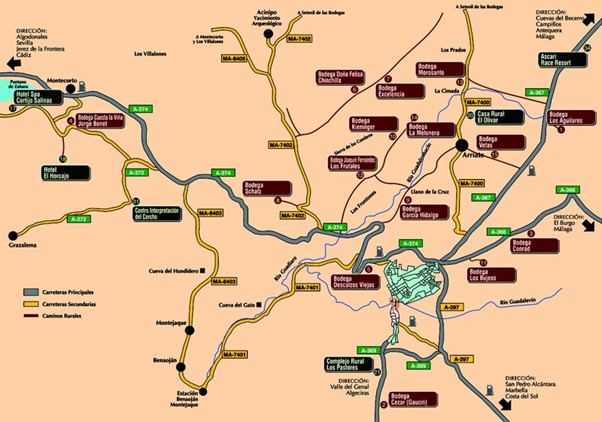
[Map courtesy of Karl Smallman, Secret Serrania]

Cheaper wines are produced in areas such as Campo de Borja, Cataluña and even Valdepeñas and represent good quality.
The wine expert Andrew J Linn has singled out a 2024 Borsao (Campo de Borja) at around € 5.50 per bottle, as representing the best quality-price ratio in the world.
In a recent SUR in English Linn tells of a young female wine-maker from the north of Spain who has moved to Ronda and transformed the wine-making process at one of the area's top wineries.
[correo del vino]
Julia Losantos at Bodega Doña Felisa
 Originally from Burgos Losantos has joined the bodega which produces the well-known Chinchilla wines, and has embarked on a subtle revolution.
A second-generation winemaker she has inherited her parents' pioneering spirit while combining that with a contemporary approach. Her philosophy is that Andalucia can rival any European wine region in elegance, complexity and freshness.
[VinoTEC]
 That said, she believes that a vineyard must be managed with ecological awareness and supported by modern wine-making techniques. One change she has made, based on the use of qvevri - large clay amphorae - originating from Armenia and Georgia some 8,000 years ago, has inspired interest from other wine-makers.
[SUR in English]
A Personal Note
I live in Ronda, within a stone's throw of several vineyards, including Doña Felisa, Friedrich Schatz, Gonzalo Beltran, Joaquin Fernandez, Kieninger and relative newcomer Badman. They all have the DO classification, so their wines are very good quality but therefore, sadly, too expensive for this OAP.
Links:
Days of (Ronda) Wine… and Roses - Secret Serrania de Ronda
Kilómetro 26 - Help me, Ronda
Ronda Wines - Are they any good?
© The Merry Tippler
Pictures:
correo del vino, FontSpace, Karl Smallman, SUR in English, VinoTEC
Thanks:
Andrew J Linn, Paul Whitelock, SUR in English
Tags:
amphorae, Andrew J Linn, AC, appellation controlee, Badman, Cadiz, Chinchilla, correo del vino, DO, denominacion de origen, Doña Felisa, ecological awareness, FontSpace, Friedrich Schatz, Galicia, Gonzala Beltran, Joaquin Fernandez, Julia Losantos, Karl Smallman, Kieninger, modern wine-making techniques, Paul Whitelock, qvevri, Ribera del Duero, Rioja, Ronda, Sierras de Malaga, SUR in English, Valencia, VinoTEC