Beyond the crowded beaches of the Costa del Sol and the bustling streets of Madrid lies a landscape that feels suspended in time. It is a land of vast, arid plains, whitewashed villages, and rolling hills crowned by stone fortresses. This is Castile-La Mancha—the legendary setting of Miguel de Cervantes’ Don Quixote.
For those seeking a journey that blends history, culture, and literature, the Ruta de Don Quijote offers a 300-kilometre circuit that brings the world's most famous knight-errant to life. Here is how to navigate this iconic loop through the soul of inland Spain.
Every great quest needs a starting point, and there is none grander than Toledo. Once the capital of the Spanish Empire, this "City of the Three Cultures" sits dramatically on a gorge overlooking the Tagus River.
Before hitting the open road, wander through the labyrinthine streets where Christian, Muslim, and Jewish legacies intertwine. From the towering Alcázar to the intricate Gothic cathedral, Toledo serves as the cultural anchor for the route. It is here that you can find numerous exhibitions dedicated to Cervantes, preparing you for the immersion into his fictional world.
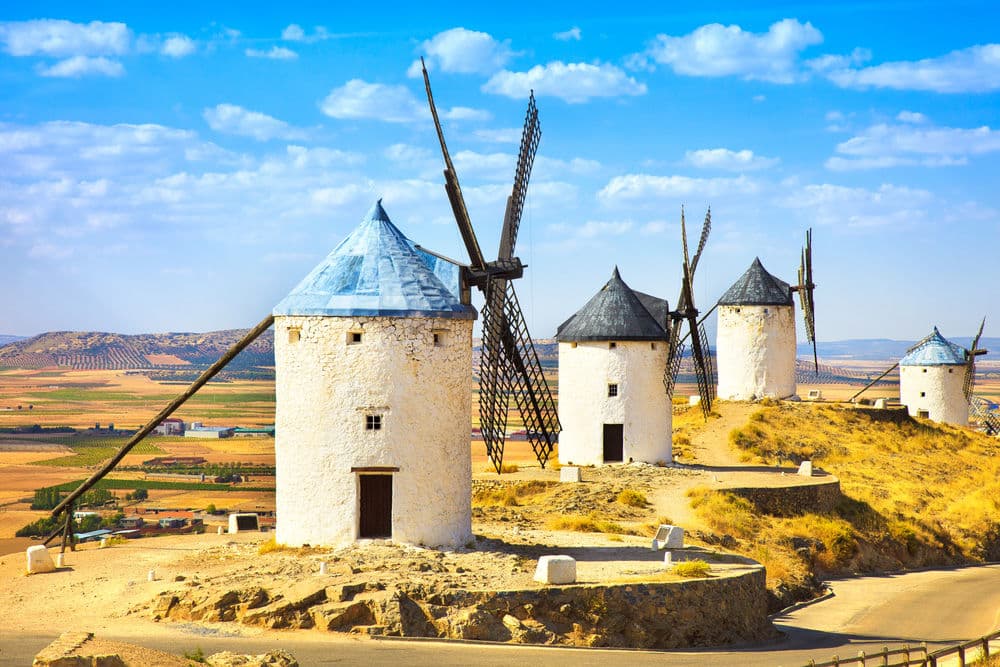
Driving sixty kilometres south, the horizon begins to shift. Emerging from the plains of La Mancha is the "Ridge of Peace" in Consuegra. Here, twelve white windmills stand in a row like silent sentinels against the sky.
It is impossible to view these structures without thinking of the famous scene where Quixote, fueled by his imagination, charges at them, believing they are monstrous giants. Next to the windmills sits the Castle of La Muela, a sturdy fortress that offers panoramic views of the scorched earth below—a landscape that has changed remarkably little since the 17th century.
Further south lies Puerto Lápice, a village that retains the charm of a medieval crossroads. The highlight here is the Venta del Quijote, a traditional Castilian inn built around a central courtyard with wooden galleries.
In the novel, this is the spot where Don Quixote was "knighted" by a bewildered innkeeper. Today, it remains a perfect place to stop for a meal of local Manchego cheese and wine, allowing you to soak in the atmosphere of an era when travellers on horseback were the norm.
A short drive leads to Alcázar de San Juan, a town steeped in both Roman history and literary mystery. Local legend claims that the Church of Santa María la Mayor houses the very baptismal font used for Miguel de Cervantes himself. Beyond the literary connection, the town’s Plaza de España, with its arcaded galleries, showcases the architectural wealth of the Spanish Golden Age.
While Consuegra is famous for its vista, Campo de Criptana is home to the most authentic windmills in the region. Several of these 16th-century structures, such as the Molino Infanto, still contain their original internal mechanisms. Walking through the town’s whitewashed streets, decorated with vibrant flower-filled courtyards, feels like walking through a life-size film set dedicated to rural Spanish tradition.
No Quixotic journey is complete without a visit to El Toboso, the home of the knight’s idealised lady, Dulcinea. The town is home to the Casa-Museo de Dulcinea, a beautifully preserved 16th-century house that recreates the domestic life of the period. As you stroll past the Church of San Antonio Abad and through the quiet, sun-drenched plazas, the line between Cervantes’ fiction and Spanish reality begins to blur.
The Ruta de Don Quijote is more than just a sightseeing tour; it is an invitation to see the world through a different lens. In the heart of inland Spain, the windmills are still turning, the castles still stand guard, and the spirit of the "ingenious hidalgo" lives on in every dusty road and blue-framed window. For the modern traveller, it is a reminder that sometimes, the most rewarding journeys are those fueled by a bit of imagination.