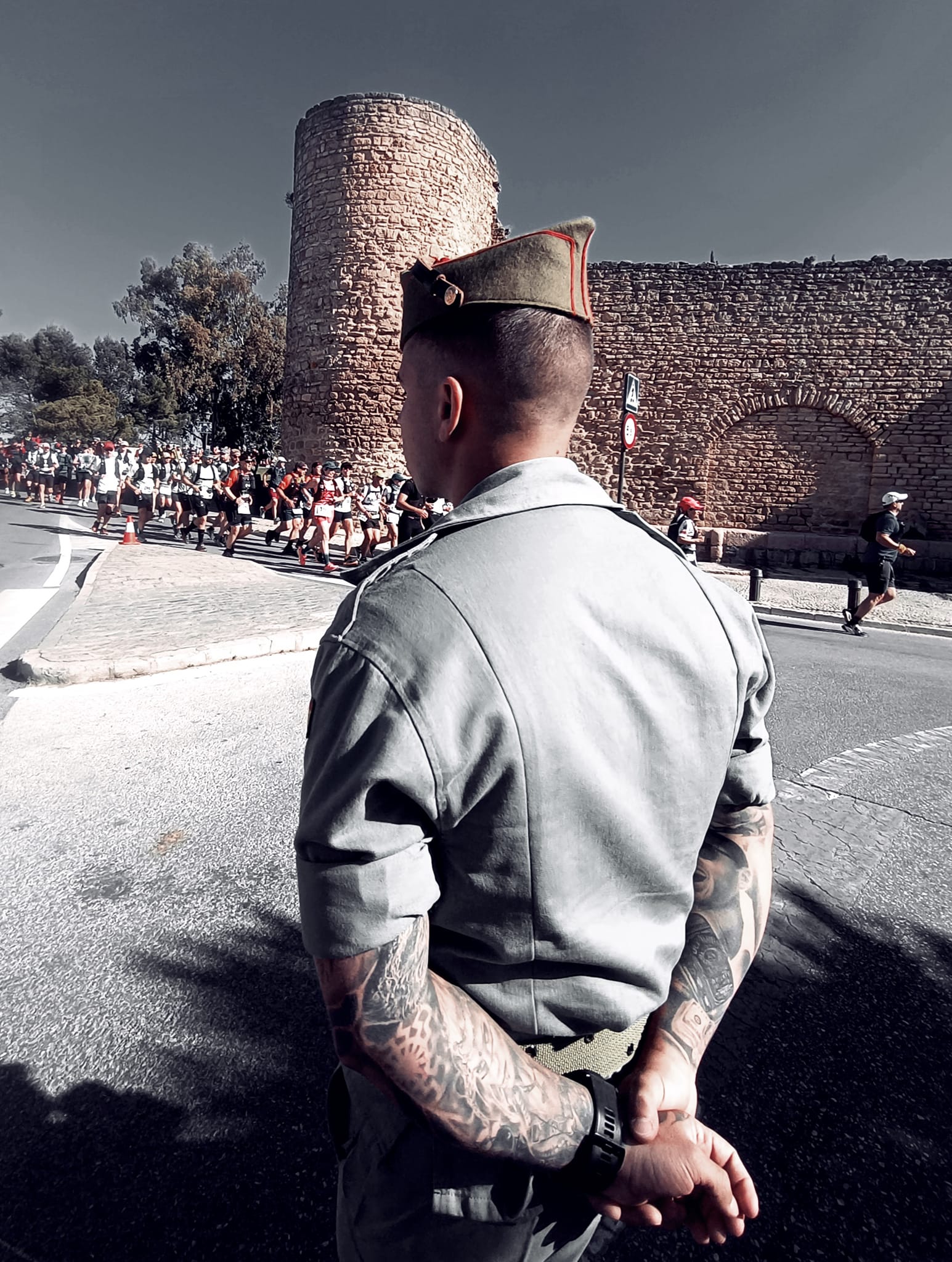
Legionnaire guarding runners as they pass through Barrio San Francisco. Photo © Karethe Linaae
Every May, thousands of athletes from Spain and around the world gather in the picturesque town of Ronda, where one of the country’s toughest tests of strength takes place. The 101-kilometre ultramarathon is considered a legendary race in Spanish trail running culture and is one of the most important “bucket list” races for ultra-athletes. Participants have just 24 hours to cover more than two marathon lengths along narrow mountain paths, steep climbs and winding descents. The route starts and ends in Ronda and passes through the historic towns of Arriate, Setenil de las Bodegas, Alcalá del Valle, Montejaque and Benaoján. But this is no Andalusian sightseeing tour. During the day, participants can face scorching sun or driving rain and bone-chilling night temperatures.

101 Ronda. Photo © Carlos Ponce
Does it tempt you, or does it sound like a punishment worse than death? Whether you’re running, biking or cheering from the sidelines, the 101 is something you absolutely must experience.
What is the 101?

The race is organised by Tercio «Alejandro Farnesio», 4º de La Legión. Photo © La Legión, Ronda
The 101 (101 Kilómetros en 24 Horas La Legión) is not just an ordinary race: it is a celebration of sport combined with legionary traditions. The race is considered one of the toughest and most iconic endurance challenges in the country. Although the Canfranc-Canfranc Ultra in the Pyrenees is more technically demanding, with steeper terrain (8,848 metres of elevation gain compared to the Ronda race’s 2,891 metres), the 101 is legendary for its combination of extreme distance, intense heat, rugged and steep terrain and, finally, the legionnaire atmosphere. Participants race against the clock and overcome physical and mental barriers to receive the coveted medal – if they finish in under 24 hours.

Mission completed. Photo © Carlos Ponce
The fastest athlete to date to finish the 101 was Kiko Martínez from Murcia, who completed the race in a record time of 8 hours, 17 minutes and 44 seconds in 2025. The oldest and most beloved athlete to complete the race was Francisco Contreras Padilla. Popularly known as “Super Paco”, he finished the ultramarathon for the last time after turning 80, despite suffering from Parkinson’s disease. He passed away in 2019 at the age of 81.
The 101 was created in 1995 by the 4th Alejandro Farnesio Regiment of the Spanish Legion in Ronda. According to Brigadier General D. José Agustín Carreras Postigo, the race is the culmination of a series of annual legionary races held in Melilla, Ceuta and Almería.
– It is not just a test for the ultra-running elite; rather, it is a grand sporting celebration and a challenge that provides unforgettable moments that will stay with the athletes forever.
The general points out that the event promotes values that constitute the essence of the legionary spirit: effort, perseverance, self-development, generosity, camaraderie and solidarity.

Solidarity and camaraderie. Photo © Carlos Ponce
Whether they are professionals or amateurs, the 101 represents a personal and collective challenge for individual and team runners, marchers and cyclists, who share a unique spirit: “We do not run alone. We run with history, with the legion and with the villages of La Serranía that encourage and cheer us on.”
May 8th to 10th, 2026

Runners by the starting line. Photo © La Legión, Ronda
The 26th edition of the race, which will gather more than 9,000 participants, takes place from May 8th to 10th. Since its inception in 1995, it has evolved from a regional race into an event of increasing international recognition – this year with participants from ten different countries. As every year, registration for the 101 sold out within minutes of going online in January.

Colourful participants. Photo © Carlos Ponce
The organisers are still maintaining the classic formats of the event: the individual and team races (running or walking) have a time limit of 24 hours, while the mountain bike competition (with 3,700 participants) has a time limit of 12 hours. In addition, there is the traditional children’s race with 1,200 participants, which this year will be held not only in Ronda, but also in towns and villages along the route.

101 km on rough country roads. Photo © Carlos Ponce
More than 900 legionnaires will be stationed along the route, along with members of the Guardia Civil, the National Police, the local police, Civil Defence and the Red Cross. Many volunteers will also man 20 aid stations and stalls, distributing, among other things, 34,000 litres of water, 25,000 litres of isotonic drinks and thousands of pieces of fruit.

Waterbreak. Photo © Carlos Ponce
Beyond the sporting aspect, the race continues to be a significant economic and tourist driver for the Serranía de Ronda area, with an expected 25,000 visitors over the weekend. Every single room for rent in Ronda and the surrounding area is booked, often months in advance.
The last push

"I did it!" Photo © Carlos Ponce
The 2026 edition will be extra taxing, as it is forecast to have periods of heavy rain and night temperatures that might drop below 10 degrees. This might not sound too cold, but when one has been running for hours and is soaked to the bone, with mud up to one’s elbows, it can take its toll.
For those of us who watch the race comfortably from the sidelines, the last few kilometres are particularly exciting. After almost 100 kilometres, the participants descend into Ronda’s deep valley for the final huge effort: climbing the last steep slopes up to the city centre and the finish line on Alameda del Tajo – an epic finish accompanied by deafening applause and cheers.

"Give me 5!" Photo © Carlos Ponce
The next day, it is evident who took part in the race – those limping slowly around, with painful expressions on their faces at every step they take. If one asks them whether they will do it again, almost everyone says NEVER! But a couple of days later, they are back at it, training because they want to do even better next year…

The day after. Photo © Carlos Ponce