 47 years ago 88% of the Spanish people voted in a referendum to approve the new Constitution, three years after the death of General Franco, dictator of Spain since the end of the Civil War in 1939 until his demise in 1975, some 36 years in total.
 Franco had "adopted" Don Juan Carlos de Borbon y Borbon, grandson of the last king of Spain, Alfonso XIII, who abdicated in 1933 when Spain became a republic, and "groomed" Juan Carlos to be the next monarch on Franco's death.
The new king's inauguration took place two days after the dictator died, on November 22nd 1975.
The young Juan Carlos [Getty Images]
A note on Constitutions
Most democracies have a written constitution. The only exception I know is the United Kingdom, which relies on legal precedent.
Spain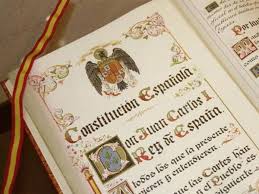
A young constitution, it has already undergone three changes: when Spain joined the European Union; when Felipe VI became king; and when Franco was effectively erased from Spain's history.
[El Confidencial]
Austria
Estabished after the end of World War II, it has already had over 100 amendments.
USA
The US Constitution, signed into law in 1789, has had a number of amendments, but the original remains unchanged.
Other countries:
France, Germany, Italy, Netherlands, Scandinavia and former eastern bloc countries all have constitutions. Other democratic countries too.
United Kingdom:
The UK does not have a written constitution. The rules and regulations are subject to the law of precedent. The Magna Carta, a document signed at Runnymede in 1215, is the nearest thing the UK has.
After Franco died what happened?
What Franco would not have expected was that the new king would lead the way in restoring Spain to full democracy within just three years, a relatively short space of time,
Attempted coup d'etat
In 1981 Lt. Col. Antonio Tejero and a group of 200 guardia civil and military stormed Las Cortes, the Spanish Parliament. Shots were fired but no-one was hurt.
The officers held the parliamentarians and ministers hostage for 18 hours, during which the King denounced the coup in a public television broadcast, calling for rule of law and the democratic government to continue.
The royal address fatally undermined the coup, and the hostage-takers surrendered the next morning and all deputies were freed.
A simultaneous coup attempt, executed by Captain General Jaime Milans del Bosch in Valencia, also failed.
Tejero, Milans del Bosch and a third conspirator, General Alfonso Armada, were sentenced to thirty years in prison. In 1988 the Spanish Supreme Court suggested pardoning Armada and Tejero; the government of Felipe González pardoned the former.
What ha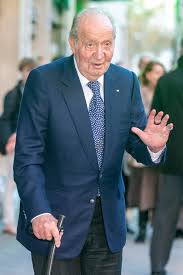 ppened many years later could not have been foreseen.
In June 2014 Juan Carlos I abdicated in favour of his son Felipe, who became el Rey Felipe VI.
Then stories of extra-marital affairs, back-handers, kick-backs and corruption began to circulate in the media and the Rey Emerito fled into exile.
A court case in London was inconclusive, so Juan Carlos returned to his exile in The Middle East. He had become persona non grata in Spain. Even his son, Felipe VI, has formally disowned him.
Juan Carlos now, a frail old man [El Mundo]
[image courtesy of Calendarr]
Links:
Día de la Constitución – what a disappointment!
The Curmudgeon
Día de la Constitución (España) - Wikipedia, la enciclopedia libre
Qué se celebra el 6 de diciembre y por qué se le llama el Día de la Constitución Española
Día de la Constitución Española, en directo los actos | Vídeo
© The History Man
Pix:
Calendarr, El Confidencial, El Mundo, Paul Whitelock
Thanks:
BBC, La 1, RNE, RTVE, Sky News, Wikipedia
Tags:
1975. 1978, 47, 88%, Alfonso XIII, back-handers, Civil War, constitution, corruption, democracy, dictator, dictatorship, Don Juan Carlos de Borbon y Borbon, extra-marital affairs, Felipe, Franco, Juan Carlos, Magna Carta, Paul Whitelock, referendum, republic, Rey Emerito, Rey Felipe VI, The Curmudgeon, The History Man,