
Mayor, Miguel Ángel Herrera Gutiérrez. Photo © Dio Rubio
In part two of the article series A Stroll Around Town with the Mayor, I visit Genalguacil and meet the mayor, Miguel Ángel Herrera Gutiérrez, who, over the past eleven years, has transformed a small village into an internationally recognised centre for art and rural development.
A living museum village

The white village of Genalguacil. Photo © Ayuntamiento de Genalguacil
From a distance, Genalguacil may look like any other Andalusian white village, but as you get closer, things start to look different. The village in the province of Málaga is officially considered one of the most beautiful in Spain, having been a member of Los Pueblos Más Bonitos de España since 2021. It is known for its spectacular location, narrow streets and white houses, and not least for being a living museum village, where sculptures and works of art decorate almost every street, plaza and alley.

Street art. Photo © Ayuntamiento de Genalguacil
The country road that leads here winds through an undulating landscape of dense oak forests. However, you should not let yourself be distracted by the natural beauty, because the locals, who know every hairpin bend like the back of their hands, tend to take the inside line – especially on steep curves.
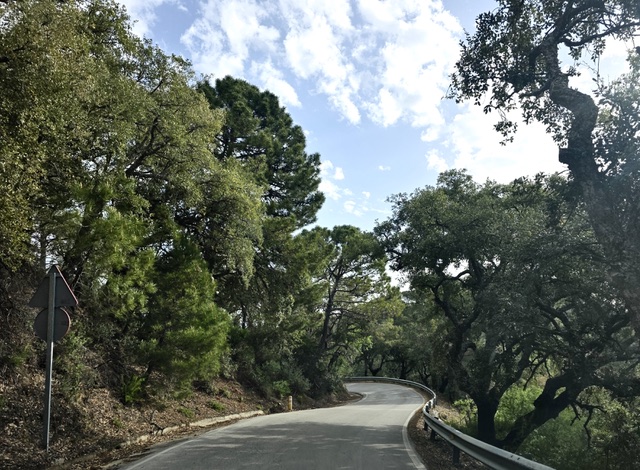
Road to Genalguacil. Photo © Karethe Linaae
If you find the twists and turns challenging, be prepared to hold your breath as you drive into the village centre on your way to the public car park. Here, you often have only a few centimetres of clearance from the walls on either side.
Looking around, you will discover sculptures that both surprise and give character to the streetscape. Some are sleek modern structures. Others, like a pencil stub mounted on a wall, make you smile, while ceramic dishes and clay pots on windowsills reflect the traditional local crafts.
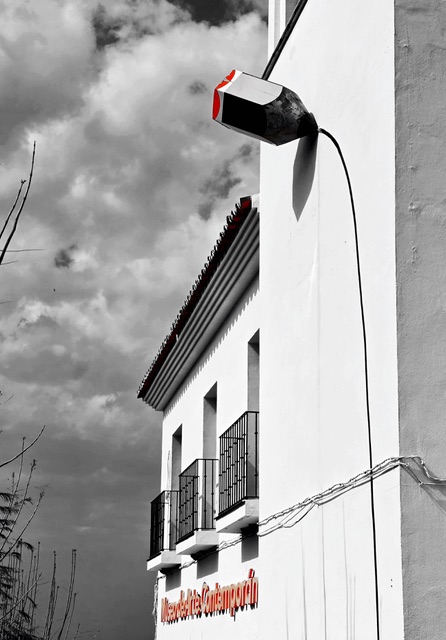
Pencil. Photo © Karethe Linaae
Every square and every little alley reveals something special, and this is precisely what makes Genalguacil so unique.
A Man of the People

Miguel Ángel, a man of the people. Photo © Dio Rubio
The plan was for us to meet at the town hall, but as always, we are a little early, so we grab a coffee at the local tavern. And who is there but the mayor himself, having a breakfast meeting before our interview?
As the head of the municipal council, Miguel Ángel Herrera Gutiérrez (48) is always on the move. Yet he takes the time to greet us and chat with the woman behind the bar while her granddaughter runs between her legs. Miguel Ángel is clearly a man of the people, highly appreciated for all he has done for this village – and that is no small thing.

Miguel Ángel in Genalguacil. Photo © Dio Rubio
After following him along narrow shortcuts through the town, we find a quiet spot for our conversation on the roof terrace of the municipal museum of contemporary art. And what a view we have!

The eagle. Photo © Ayuntamiento de Genalguacil
How did you end up as mayor, and why here?
I was born and raised in Genalguacil, and after my studies, I moved back to start my own business. Initially, it was a small grocery store, before I eventually opened another one and began distributing food to restaurants in the area. Entrepreneurship has always been a part of my life. I have been mayor for almost 15 years, and my goal has always been to develop a project that is different from what you find in other small towns.
What specific projects have you undertaken to put Genalguacil on the map?
For me, the surroundings have always been important. Genalguacil and Valle del Genal are areas where nature plays a central role, but they are also places that need revitalisation. Depopulation has been – and still is – a challenge. That is why we further developed the concept of Genalguacil Pueblo Museo (Museum Village).
The project started back in 1994 with Encuentros de Arte, an artist residency and workshop programme held as a 15-day gathering every two years. In 2011, when I took office, we wanted to give art and culture a much more central role. We began building a year-round cultural programme with artist residencies and invitations to both Spanish and international artists. The idea was to let artists work directly here and develop projects in collaboration with the village and its inhabitants. At the same time, we began inviting renowned curators who could help take the project further. Today, Genalguacil has become a reference point for art and culture, not only in Spain but also internationally.
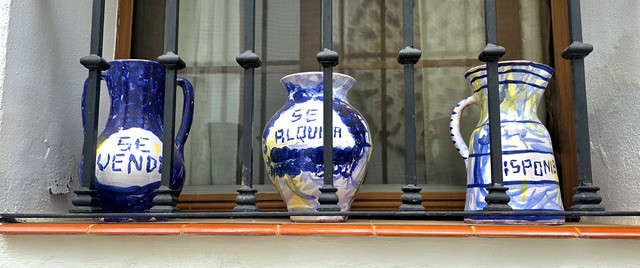
Art on windowsill. Photo © Karethe Linaae
How did the Museum of Contemporary Art come about, and what is its goal today?
Museo de Arte Contemporáneo de Genalguacil was established as a physical space for the collection that has grown through the various editions of Encuentros de Arte. The building was inaugurated in 2004, but it was only from 2011 that we expanded the exhibition concept in a more professional direction for contemporary art.
Today, the museum functions not only as a repository but also as a living space for artistic research, collaboration with the local community and cultural production. The main goal of the museum, as with the other initiatives we have developed in Genalguacil, is to counteract depopulation in rural areas. The work is based on five pillars: tradition, art, culture, nature and innovation. This is an approach we adopted early on. The museum, the museum village project, which includes an open-air museum, and more than 300 artists have all contributed to making Genalguacil an international reference point for innovation in rural areas.

Museo de Arte Contemporáneo de Genalguacil. Photo © Ayuntamiento de Genalguacil
Genalguacil is part of the EU's Rural Development Programme. What is that about?
Through the museum village project and our innovation-based approach, we have established the International Laboratory for Rural Innovation in Genalguacil. Together with leading European partners, we are now working on projects that aim to address the challenge of depopulation in rural areas. One of the most important is Pacesetters, which forms part of the EU programme Horizon Europe – one of the EU's leading research programmes. In this context, Genalguacil functions as a pilot project and a so-called Real World Lab.
It is quite remarkable that a small village like ours participates in projects of this scale. It is not only about what is happening here locally, but also about how we can function as a catalyst for other villages and rural areas across Europe.

Sculpture. Photo © Karethe Linaae
Part of the charm
Genalguacil is located only 43 km from the Costa del Sol with a direct road from Estepona on the MA-8301. For some, the country road may feel a bit challenging, but according to the mayor, it's part of the village's charm.
Is the destination worth all the curves?
Absolutely! It only takes me about an hour and ten minutes to drive here from Estepona, but the curves are unavoidable. At the same time, they are part of the charm. If we had a motorway all the way here, much of the village's essence would have been lost. The road has served as a kind of buffer against mass tourism, and that's precisely what makes the place feel so serene and undisturbed.
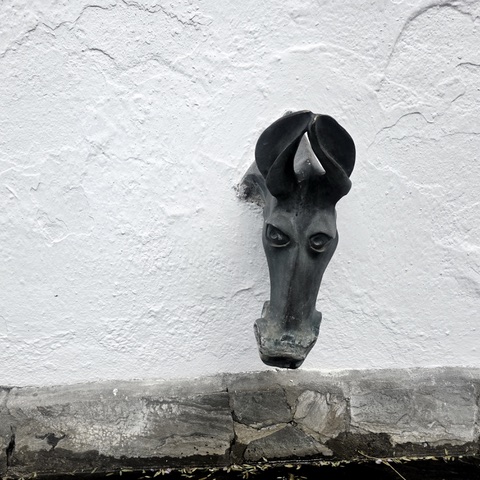
Horse fountain. Photo © Karethe Linaae
Who lives here, and what do they do?
We have around 400 inhabitants. In the past, the population fell sharply, and it still fluctuates, but most importantly, there is now a stable and committed local population. Several residents work on the coast, and some young people move away to study or work. At the same time, it is easier to build a life here today – especially with the possibilities offered by remote work.
The local economy is largely linked to culture, agriculture and forestry, particularly chestnut and cork production. The valley has a microclimate that makes the soil very fertile, and almost everyone has a small garden plot where they grow fruit and vegetables. Tourism is increasingly employing the local population, but the positive thing is that it is not the type of tourism you see on the Costa del Sol. Visitors who come here tend to be more interested in local products, arts and crafts.

The names of all the residents are listed on the museum wall. Photo © Ayuntamiento de Genalguacil
Are there any foreign residents in the village?
Yes, there are several foreigners living here. Many come to try village life by renting before potentially buying a house and settling down. Among them is a French artist couple who settled here permanently, which says a lot about how people find their place here. It's lovely to see how they have become part of the local community. Genalguacil often attracts interesting profiles – curators, collectors and people from the worlds of art, science and innovation.
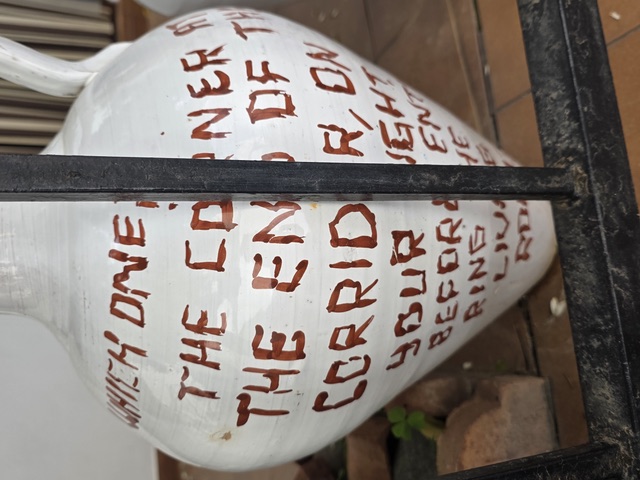
Vase. Photo © Karethe Linaae
Do you have a favourite place in the village?
It's hard to choose just one. What I like best is the contrast – the white houses set against the vast green landscape. After all the rainfall this winter, the spring has been absolutely spectacular. The name Genalguacil, which comes from Arabic, means something along the lines of paradise or oasis, so even back then, the area was considered special.

Genalguacil is surrounded by nature. Photo © Karethe Linaae
What are the biggest challenges and opportunities for villages such as Genalguacil?
One of the biggest challenges is getting the authorities to understand that sustainability is also about supporting rural areas. Villages contribute an invaluable cultural heritage, and this needs to be recognised to a greater extent. In addition, there is a need for better communications and more stable basic services. At the same time, there are great opportunities. The high housing prices in the towns along the Costa del Sol make the interior villages more attractive for entrepreneurship and provide room for a better quality of life, especially for families with children.

Street art. Photo © Karethe Linaae
What can tourists expect to see in Genalguacil?
The first thing to visit is the contemporary art museum, but the main experience is probably the village itself, where more than 250 works of art are scattered throughout the streets.

Miguel Ángel under chair arch. Photo © Dio Rubio
In addition, you can visit the craft workshops, which are an added bonus for anyone interested in arts and crafts. Shoemakers, artists who work with natural materials, textile artists and other local creators live and work in the village. Their workshops are usually open, and you can simply drop by. If you would like to sign up for a workshop, we recommend contacting the museum in advance.
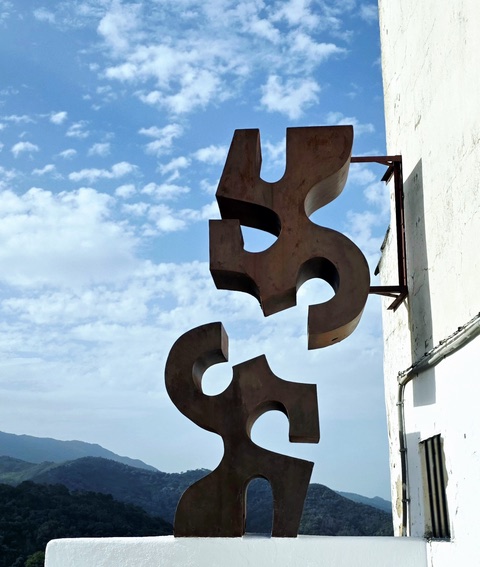
Sculptures. Photo © Karethe Linaae
For history buffs, there is a 17th-century church built on the foundations of a former Arab mosque. Around the village, there are traces of older settlements, and the area has a long history of mining dating back to Phoenician times, particularly in the Sierra Bermeja.
In terms of accommodation, Genalguacil has gradually gained more casas rurales, and many former family homes have been restored and are now used by both visitors and visiting artists. There are also an inn (posada) and several small restaurants – including a vegan one. The latter may come as a surprise, but it suits the type of visitor who comes here.
When is the best time of year to visit, and what about special local celebrations?
Genalguacil is a destination that can be visited year-round, with an active cultural programme in every season. However, the first half of August is particularly interesting, when Encuentros de Arte is held in even-numbered years and Arte Vivo in odd-numbered years. That's when the village is at its most vibrant.
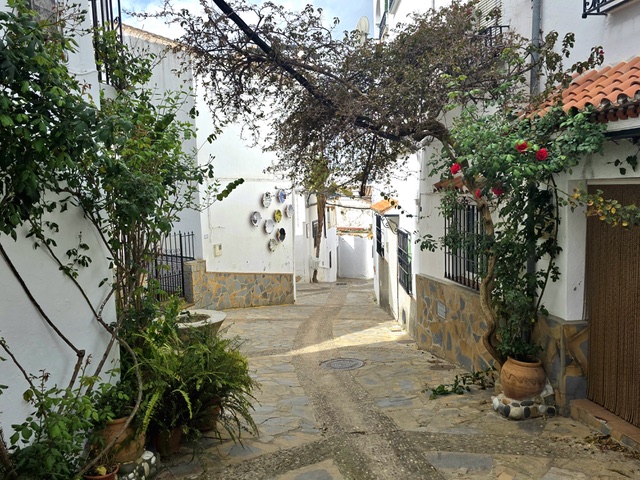
Traditional village alley. Photo © Karethe Linaae
GENALGUACIL AT A GLANCE
White village in the province of Málaga
Population: 352 (2025)
Altitude: 500 m
Mayor: Miguel Ángel Herrera Gutiérrez
Did you know? More than 250 sculptures are scattered throughout the village’s streets and squares.