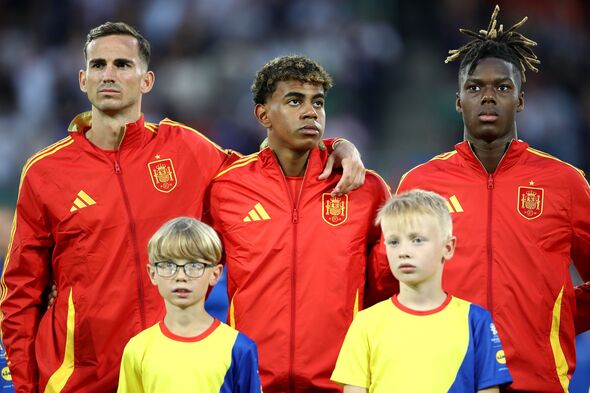
The wait is almost over. As we secure our spots at the local terrazas across the peninsula to watch tomorrow's World Cup Final, the pre-match tension will be palpable. But just before the referee blows the starting whistle, you will notice a stark contrast. While the opposing team belts out their national anthem with hands clenched over their hearts, the Spanish squad—from seasoned veterans to the latest prodigies produced by the country's elite international youth academies—will stand stoically, simply humming a rhythmic "lo, lo, lo."
For those of us developing youth talent in international football academies, the psychological unity generated by a roaring pre-match anthem is undeniable. Yet, Spain proves that you do not need words to forge an unbreakable team spirit on the pitch.
So, why does one of the world's greatest footballing nations lack words to its most important song?
The Exclusive Club of Wordless Anthems
If you have ever assumed the television broadcast lost its audio feed during the Spanish pre-match line-up, you are not alone. Spain’s anthem, the Marcha Real (Royal March), is one of only four national anthems in the world completely devoid of official lyrics.
| Country |
Anthem Title |
Reason for No Lyrics |
| Spain |
Marcha Real |
Deep historical political divisions over proposed verses. |
| Bosnia & Herzegovina |
Državna himna |
Designed to avoid alienating any specific ethnic group. |
| Kosovo |
Europe |
Adopted without words to maintain strict ethnic neutrality. |
| San Marino |
Inno Nazionale |
A historical instrumental march that simply never adopted its drafted lyrics. |
From 18th-Century Grenadiers to the World Stage
The melody you will hear echoing across the stadium tomorrow was never commissioned by a king or a political leader to represent the nation. It started as a popular military beat.
-
1761: The tune first appeared in a military handbook as the Marcha Granadera (March of the Grenadiers).
-
1770: Because the grenadiers frequently paraded in front of the royal family in Madrid, King Charles III grew fond of the tune and officially declared it a "March of Honour."
-
The Royal Transition: As subsequent monarchs, like Alfonso XII, began touring the country with the grenadiers, the public began referring to the tune as the Marcha Real. It became the national anthem entirely through popular Spanish custom.
EOS Insider Pro-Tip: In a truly bizarre administrative twist, the modern orchestral arrangement of the anthem was copyrighted by a 20th-century musician named Bartolomé Pérez Casas. Until 1997, the Spanish government had to pay royalties to his heirs every time it was played! The state finally bought the copyright outright for roughly 130 million pesetas (around £650,000 in today’s money) to secure its free use for events like the World Cup.
Why Can't Spain Agree on the Words?
The short answer? Politics. Spain has tried—and spectacularly failed—to add words to the Marcha Real for over 150 years.
-
The 1870 Contest: General Juan Prim launched a national competition for poets and musicians to write lyrics. The jury failed to agree on a winner, claiming the instrumental march was already "artistically the best."
-
The Shadow of Dictatorship: During the 1928 dictatorship of Primo de Rivera, writer José María Pemán penned a set of lyrics. After the Spanish Civil War, these lyrics were slightly modified (changing phrases to align with fascist imagery, like "yokes and arrows") and widely sung during General Francisco Franco's regime. Because of this dark association, those lyrics were immediately scrapped when Spain transitioned back to democracy in 1978.
-
The 2007 Olympic Disaster: To boost Madrid's bid for the 2016 Olympics, the Spanish Olympic Committee launched a massive lyric-writing contest. A winning entry was selected and even rehearsed by opera legend Plácido Domingo. However, it was leaked to the press, aggressively mocked for being "stale" and "banal," and drew such fierce political backlash from regional groups that the committee binned the lyrics before the government could even vote on them.
Cultural Warning: If you hear older Spanish patrons passionately singing actual words to the anthem at your local bar tomorrow, they are likely reciting the Franco-era Pemán verses. These lyrics remain highly divisive and carry heavy right-wing connotations. For expats wanting to join in the stadium camaraderie, it is safest to stick to a universally accepted, enthusiastic "lo, lo, lo, lo."
As the team steps onto the pitch tomorrow for the ultimate test in world football, that familiar, wordless brass melody will ring out. Whether you are watching from a packed sports bar in Alicante or hosting a barbecue on the Costa del Sol, it is the perfect moment to embrace a truly unique piece of Spanish culture.
How will you be watching the World Cup Final tomorrow? Do you think Spain should commission new lyrics once and for all, or is the roaring "lo, lo, lo" tradition better left untouched? Let us know your match-day plans and thoughts in the comments below, and join the pre-game banter over on the Eye on Spain forums!
This clip offers a concise breakdown of the cultural and political hurdles that have repeatedly stopped Spain from adopting official lyrics.